Showing posts with label Recipes. Show all posts

Sunday, November 29, 2009

GeneaBloggers’ Cookbook: Snack Bars


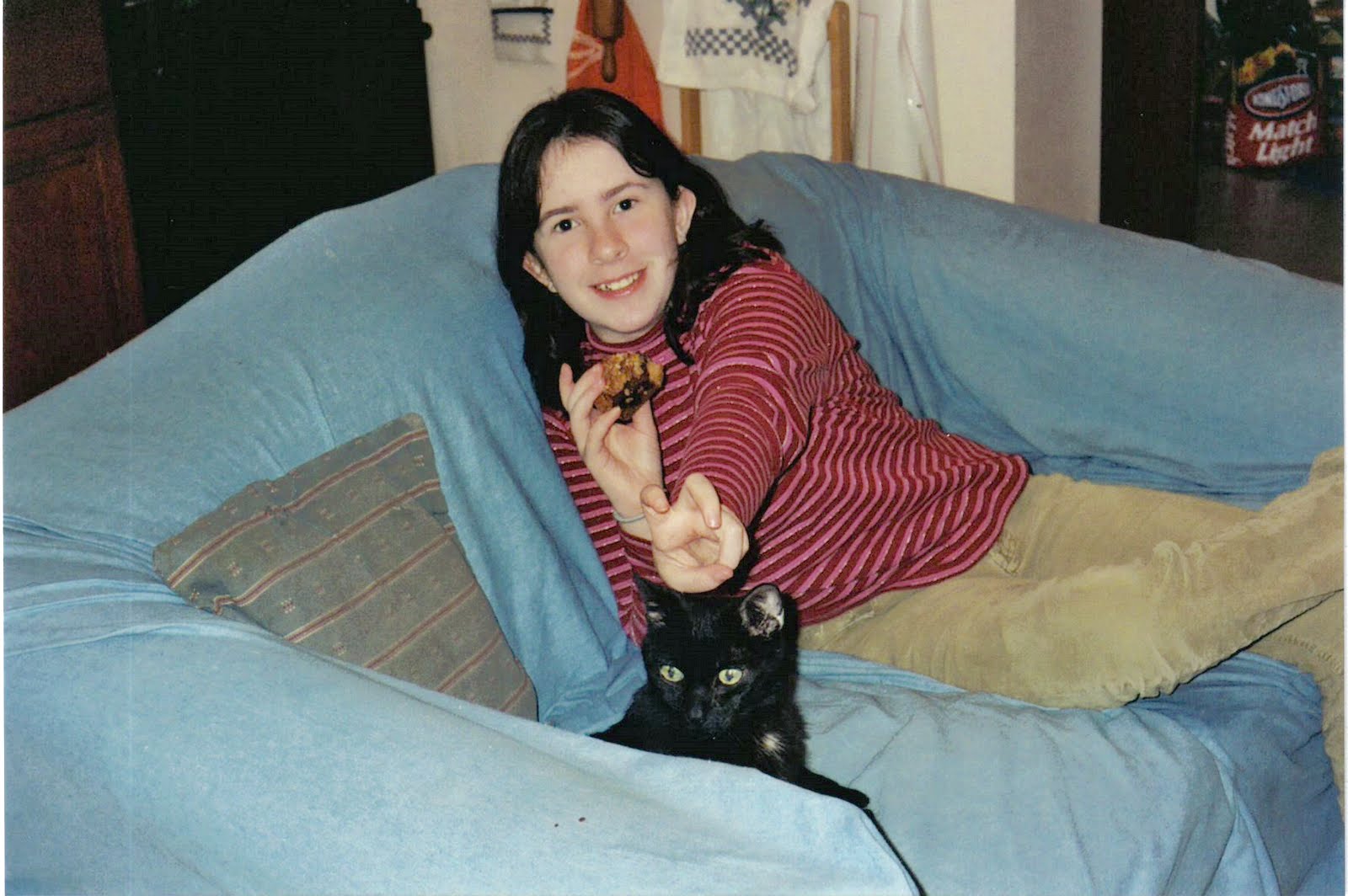
(Younger daughter enjoying a snack bar on Christmas morning, together with Rocky)

I first found the recipe for these snack bars back when I was in college. They’re sort of like fudge in between oatmeal cookies, with pecans in both the fudge and oatmeal parts. They are one of my family’s two favorite Christmas desserts, the other one being Bohemian Kolaches.

Snack Bars

1 12-oz. package semi-sweet chocolate pieces
1 14-oz. can sweetened condensed milk
Butter or margarine, softened (1 cup + 3 Tablespoons)
2 cups pecans, chopped (or more if you really love pecans)
Vanilla extract
3 cups all-purpose flour
1-3/4 cups packed light brown sugar
3 eggs
1-1/2 teaspoons baking soda
2 cups quick-cooking oats
3/4 teaspoon salt

In a double boiler over hot, not boiling, water (or in a heavy 1-quart saucepan over low heat), mix chocolate pieces, sweetened condensed milk, and 3 Tablespoons butter, stirring occasionally until chocolate is melted and mixture is smooth. Stir in 3/4 cups chopped pecans and 1 teaspoon vanilla. Remove from heat; keep warm. Preheat oven to 350 degrees. Grease 13”x9” baking pan. Into large bowl, measure flour, brown sugar, eggs, baking soda, salt, 1 cup butter, and 1 Tablespoon vanilla. With mixer at low speed, beat until well mixed, constantly scraping bowl with rubber spatula. Increase speed to medium and beat 3 minutes, occasionally scraping bowl. With spoon, stir in oats and remaining nuts until well blended. Press half of dough onto bottom of baking pan. Spread chocolate mixture over dough. Drop remaining dough by teaspoonfuls to cover chocolate mixture. Bake 30-35 minutes (the original recipe had a longer baking time, but this seems to do it for me in my glass baking pan). Cool completely in pan on wire rack. Invert pan on cutting board. Cut lengthwise into four strips; cut each strip into 12 pieces.

Sunday, April 19, 2009

Easter Traditions in the Eastern Churches: The Easter Basket

The general logic behind the selection of foods that go into the Easter basket among Eastern Christians (Orthodox and Greek Catholics) in Europe is to include the items we have been abstaining from during the period of fasting. For the Eastern churches, this generally includes the following: meat, eggs, dairy products, fish with backbones, alcoholic beverages, and olive oil. These reflect foods that were considered “rich men’s food.” Thus, lobster is allowed, because in olden times it would have meant crayfish, which was a poor man’s food. It is encouraged to set aside the money saved by not purchasing these foods to be used for alms.

The Easter basket is thus filled with some fairly rich food: ham, sausage, pork, and an abundance of eggs: boiled eggs and egg-rich breads such as the Paska, the traditional slightly sweet Easter bread which is often decorated with strips of the dough in the form of braids and three-bar crosses. In this country items made of chocolate (eggs, bunnies, crosses, lambs, etc.) are frequently added to the basket.

After midnight liturgy in some Eastern churches, the baskets are taken to be blessed. In our church, the priests dip a brush into holy water and sprinkle the baskets and congregants (occasionally zapping one another in a sort of gentle “holy water fight”).

Another egg-rich item found in some baskets is the hrutka, or egg cheese. Like the Paska, it is slightly sweet . Below is the recipe I use:

HRUTKA

1-1/2 quarts milk (whole or 2%)
1 dozen eggs
1/2 cup sugar
1 teaspoon vanilla
1 teaspoon salt.

Beat eggs. Heat milk in microwave until quite warm. Add about 1 cup milk to beaten eggs and stir well. Then add eggs to milk and stir well. Add salt, vanilla, and sugar to egg mixture. Start heating on high heat in microwave oven. Stir every 4-5 minutes until mixture begins to get thick. Continue cooking, stirring every few minutes until mixture gets very clumpy. (When a watery whey starts to separate out, the eggs and milk should be sufficiently cooked.) Pour into a cheesecloth bag or piece of cheesecloth. (I use slotted ladles to do this, which helps to start the process of draining.) Tie tightly, then press with spoon to remove excess liquid. Let hang several hours, or overnight. Refrigerate.

Below are some pictures of our Easter basket over the years. The second picture from the bottom shows a Paska (the candle symbolizes Christ as the Light of the World), and the bottom picture shows a row of Easter baskets getting blessed.


Sunday, February 15, 2009

I Found the Recipe!

In my post on Family Food, I reminisced about a fantastic candy made by my Aunt Rene and later also by my mother, mostly at Christmas time. Yesterday I decided to do some “extra special” cleaning in some places that … um, well … I don’t clean very often. Like the corner of the dining room next to the bookcase that’s hard to reach for various reasons. And there was a pile of (very dusty) boxes for 3x5 cards, i.e., a bunch of my old recipe boxes. I suspected one of them might hold the longed-for recipe, and sure enough, I quickly found the recipe.

And what was the name on the recipe for these mouth-watering delights? … “Candy Balls.” So here’s the recipe, folks.

Candy Balls

Mix together 1 stick oleo, 1 can Eagle milk, 2 boxes powdered sugar, 2 cans coconut, 4 c. pecans; chill 2 hrs. Take out & roll into balls. Rechill. Melt in double boiler 2 packages chocolate chips, ¼ lb. paraffin. Stick toothpicks into balls & dip them into hot chocolate. Rechill. Dip them over as long as there is any chocolate left. For variety, dip balls into cherry juice before dipping in chocolate.

Now if I can just find Photo Album Number 4.